Stoic Causality
“Amor fati, to want the event, has never been to resign oneself, still less to play the clown or the mountebank, but to extract from our actions and passions that surface refulgence, to counter-effectuate the event, to accompany that effect without body, that part which goes beyond the accomplishment, the immaculate part. A love of life which can say yes to death.” (G. Deleuze. Dialogues)
That Stoicism - in its trinitarian manifestation of physics, logic, ethics - aims to be systematic is well-known but how does physics and logic relate to the kind of Stoic ethics (Amor fati) that Deleuze hints at? We look at Stoic notion of causality as the common theme across the three through Deleuze’s interpretation (in Logique du sens) of Emile Bréhier’s work, La théorie des incorporels dans l’ancien stoïcisme.
What kinds of question invoke causality?
- What makes the flesh to be cut by a scalpel?
- What makes a cone or a cylinder roll when pushed?
- What makes an individual assent to something?
- What causes a illness, and what can help manage it?
- Who’s responsible for a crime?
Why are such questions important? In all cases, they imply:
- Agency: the ability or power to produce or sustain some effect
- Evaluation: the importance of the effects produced
In many cases, they also demand:
- Attribution: the identity of the cause
- Casuistry: a determination of the conditions under which causes produce effects
Physics
Causes, for the Stoics, are bodies or mixtures of bodies:
- Bodies determine “states of affair,” physical qualities, tensions, actions, passions.
- Mixtures are in bodies, and in the depth of bodies: a body penetrates another and coexists with it in all of its parts, like a drop of wine in the ocean, or fire in iron. One body withdraws from another, like liquid from a vase. Mixtures in general determine the quantitative and qualitative states of affairs: “
- “At the limit, there is a unity of al bodies in virtue of a primordial Fire into which they become absorbed and from which they develop according to their respective tensions.”
- “But to the degree that there is a unity of bodies among themselves, to the degree that there is a unity of active and passive principles, a cosmic present embraces the entire universe: only bodies exist in space, and only the present exists in time.”
- Deleuze does not address the questions of the identity and unity of bodies or mixtures:
- The text implies that bodies occupy space.
- “The Stoics describe bodies as whatever has ‘threefold extension (314) together with resistance (τὸ τριχῇ διασταστὸν μετὰ ἀντιτυπίας),’ (315) and, they consider contact as crucial for bodies’ interaction. (316) It is important that bodies present both characteristics, three-dimensionality (length, breadth, and depth) and resistance, since on the one hand, void, which is not a body, is also extended, (317) and, on the other hand, because three-dimensionality seems a necessary condition for something to have contact with other bodies, and present resistance. However, resistance needs to be carefully differentiated from two similar concepts: impenetrability and limitation.” [7]
- From the point of view pf physics, the dimensional requirement may be relaxed: a body might be an n-dimensional entity with a (n-1)-dimensional surface. It is the surface that is necessary for contact.
- One reason to avoid the questions of identity and unity may be that bodies are not necessarily individuals (to whom questions of identity and unity apply) but also processes (“Unity, which is characteristic of the individual being, and identity, which authorizes the usage of the principle of the excluded middle, do not apply to pre-individual being…” G. Simondon)
- An open problem here might be the relationship between body and place: they seem to assume one another.
Effects, for the Stoics, are logical or dialectical attributes of bodies or mixtures:
- They are incorporeal: “They are neither agents nor patients, but results of actions and passions…not things or facts, but events.”
- “We can not say that they exist, but rather that they subsist or inhere (having this minimum of being which is appropriate to that which is not a thing, a nonexisting entity).”
- “Incorporeal effects are never themselves causes in relation to each other; rather, they are only “quasi-causes following laws which perhaps express in each case the relative unity or mixture of bodies on which they depend for their real causes.”
- ” They are not living presents, but infinitives: the unlimited Aion, the becoming which divides itself infinitely in past and future and always eludes the present.”
- “The Stoics’ incorporeals include, at least in its orthodox list, time (χρόνος), place (τόπος), sayables (λεκτά), and void” [7]
- “Dialectics is precisely this science of incorporeal events as they are expressed in propositions, and of the connections between events as they are expressed in relations between propositions.”
- “Events are like crystals, they become and grow only out of the edges, or on the edge.”
- “It is the characteristic of events to be expressed or expressible, uttered or utterable, in propositions which are at least possible.”
Finally, “the Stoics hold the causal relation to be symmetrical. Bodies are causes to each other, Clement asserts. The knife is cause to the flesh and the flesh cause to the knife. The knife causes the predicate of the flesh (i.e., ‘being cut’), while the flesh causes the predicate of the knife (i.e., ‘cutting’). It thus turns out that Stoic causation is a tetradic relation. (9) It involves two bodies and two predicates, two causes and two effects.” [4] 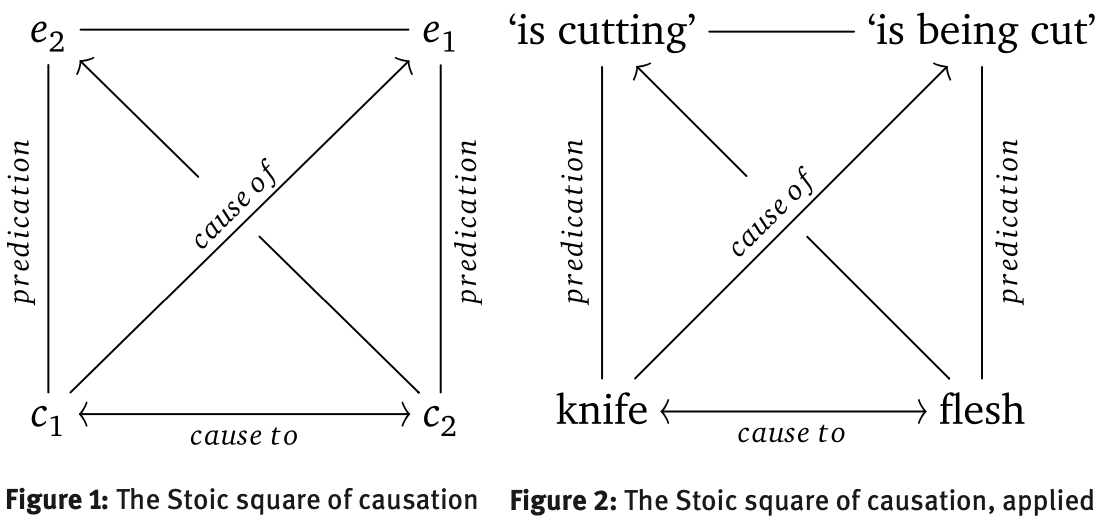
- This tetradic relation is implied in Deleuze, at least for at least of one type of incorporeals, i.e. events: “The event, being itself impassive, allows the active and the passive to be interchanged more easily, since it is neither the one nor the other, but rather their common result (to cut - to be cut). Concerning the cause and the effect, events, being always only effects, are better able to form among themselves functions of quasi-causes or relations of quasi-causality which are always reversible (the wound and the scar).” [1, pg. 8]
- Many commentators, however, argue for a triadic relation e.g. “So when Clement reports that the scalpel is the cause to the flesh of being cut, and the flesh is the cause to the scalpel of cutting, the flesh is not the cause in an active strict sense, but only insofar as it is in a fit disposition to be cut. This means that the Stoic causation in Cement’s report is triadic, and not, as Totschnig (2013, 122–123) suggests, tetradic.” Though one might make the same argument of the knife: it also needs to be in a fit disposition to cut.
To summarize:
| Source | Something | Category | Function/Relation | Mereology | Typology |
| Bobzein | Cause | Corporeal | Relative to the agent and patient | interconnected by the ‘active principle’ | Perfect and principal causes (necessitate their effects); auxiliary and proximate causes |
| Deleuze | Cause | Corporeal | Mixtures of bodies that determine qualities and properties (states of affairs, actions, passions) | interconnected by the primordial Fire | - |
| Deleuze | Effect | Incorporeal | Results (logical and dialectical attributes) of mixtures | Effects may relate to each other as quasi-causes | - |
What’s quirky about this view of causality?
- “This symmetry in the Stoic conception is most remarkable. It runs counter, it seems, to an essential element of the idea of causation, namely, directionality.” [4]
- “This is the simultaneity of a becoming whose characteristic is to elude the present.” [1, pg. 1]
- It acknowledges our presence as philosopher/observer without making the world about humans or our conception - since we, who reason with effects, cannot assume causal powers through some essential knowledge.
- “Effects” - proposition, claims - still have some modicum of being. They don’t exist like bodies: they are consigned to “subsistence”: powerless but not impermanent.
What are the implications of this view of causality?
- It challenges philosophical Idealism, or essentialism, while preserving a kind of materialism:
- “For if bodies with their states, qualities, and quantities, assume all the characteristics of substance and cause, conversely, the characteristics of the Idea are relegated to the other side, that is to this impassive extra-Being which is sterile, inefficacious, and on the surface of things: the ideational or the incorporeal can no longer be anything other than an “effect.””
- “The Stoics certainly rejected Platonic forms and denied any causal efficacy and ontological priority to incorporeal things.” [9]
- It gives a novel view of determinism, or freedom:
- “Thus freedom is preserved in two complementary manners: once in the interiority of destiny as a connection between causes, and once more in the exteriority of events as a bond of effects. For this reason the Stoics can oppose destiny and necessity.”
- This, Chrysippus, in turn refines by introducing modality (necessity vs sufficiency) into his logic:
- “if everything takes place by fate, it does indeed follow that everything takes place from antecedent causes, but not from principal and perfect but auxiliary and proximate causes. And if these causes themselves are not in our power, it does not follow that desire also is not in our power. On the other hand if we were to say that all things happen from perfect and principal causes, it would then follow that, as those causes are not in our power, desire would not be in our power either.” [8]
Logic
“Logic is divided into rhetoric and dialectic, and the latter into the study on language as sound and the study of language as what is said, the λεχτόν. The first part includes parts of speech, “solecism [wrong order of words]” and barbarism and poems and ambiguities and harmonious utterance and music” which, roughly, is a province of phonetics and syntax. The second part of dialectic is devoted to the meaning of language and include the study of presentations (φαντασίαι), lekta and “arguments and modes and syllogisms and fallacies,” and so this part is the domain of syntax (logical reasoning), semantics, and epistemology.” [11]
Even if the Stoic didn’t, one could similarly add writing as well as drawing as distinct branches of rhetoric and dialectic. Writing, in its first part, would include phonetic writing systems and organization of the written word or words, foreign scripts, ambiguities, and proper writing and typing, and calligraphy; the second part includes the use of symbolic logic, and the organization of introductions and treatises of logic. Drawing, in its first part, may include organization of lines, points, and fields; blots and illusions, representations as well as beautiful soup; the second part includes the use of venn diagrams, graphical logic, algebraic geometry, technical drawing, and architecture.
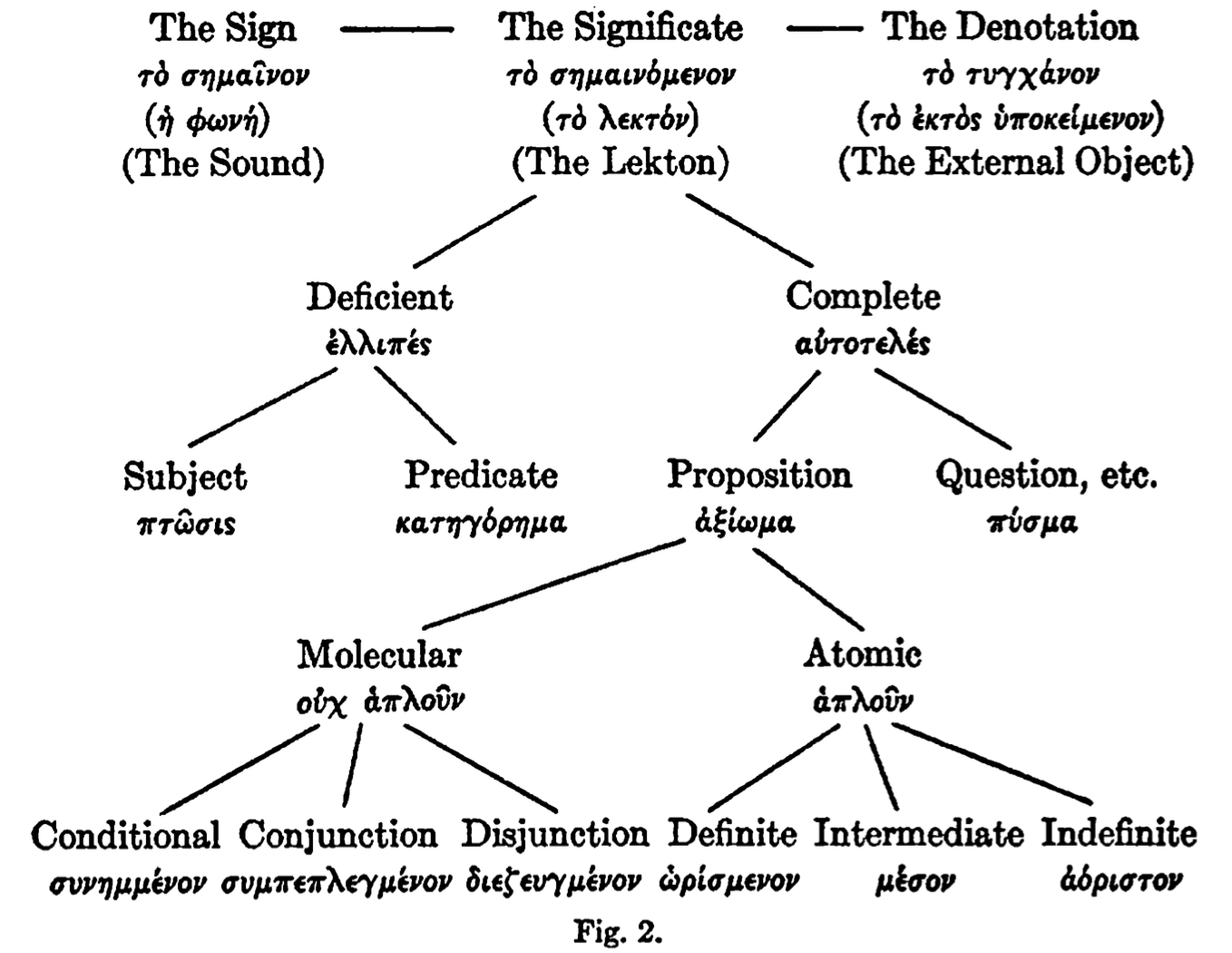
What all the typology boils down to is sense, or meaning. How do we make sense of the world? This is perhaps why, for the Stoics, logic is entryway to philosophy [13].
“Frege describes the sense as being “between” the subjective idea and the denoted object; this is parallel to Ammonius’ description of the Lekton as a jJ.EfTOV between the thought (vo’TIJ.ta) and the thing (TO 7rpo.’Yp,a).6” [14] …
Ethics
“Stoic ethics is concerned with the event; it consists of wiling the event as such, that is, of willing that which occurs insofar as it does occur. We cannot yet evaluate the import of these formulations. But in any case, how could the event be grasped and willed without its being referred to the corporeal cause from which it results and, through this cause, to the unity of causes as Physics?” [1, pg. 143]
‘“Everything was in order with the events of my life before I made them mine; to live them is to find myself tempted to become their equal, as if they had to get from me only that which they have that is best and most perfect.”’ [1, pg. 148]
References
- G. Deleuze. Logic of Sense.
- E. Brehier. La Théorie Des Incorporels Dans L’ancien Stoïcisme (1908).
- S. Bobzien. Chrysippus’ Theory of Causes. pdf
- W. Totschnig. Bodies and Their Effects: The Stoics on Causation and Incorporeals (2013). pdf
- https://www.cellsignal.com/pathways/receptors-signaling-to-mapk-erk
- D. Laertius. Lives of Philosophers. pdf
- S. D. Vazquez Hernandez. How the Stoics Solve Plato’s Greatest Difficulty: Causality and Responsibility in Plato and the Stoics. pdf
- Cicero. De Fato. pdf
- D. Vázquez. Theories of Causation in Ancient Stoicism. pdf
- S. Bobzien. Early Stoic Determinism. pdf
- A. Drozdek. Lekton: Stoic Logic and Ontology (2002). Acta Antiqua. pdf
- Selected bibliography on Ancient Stoic Ontology pdf
- K. Ierodiakonou. The Stoic division of philosophy (1993). pdf
- B. Mates. Stoic Logic. pdf